
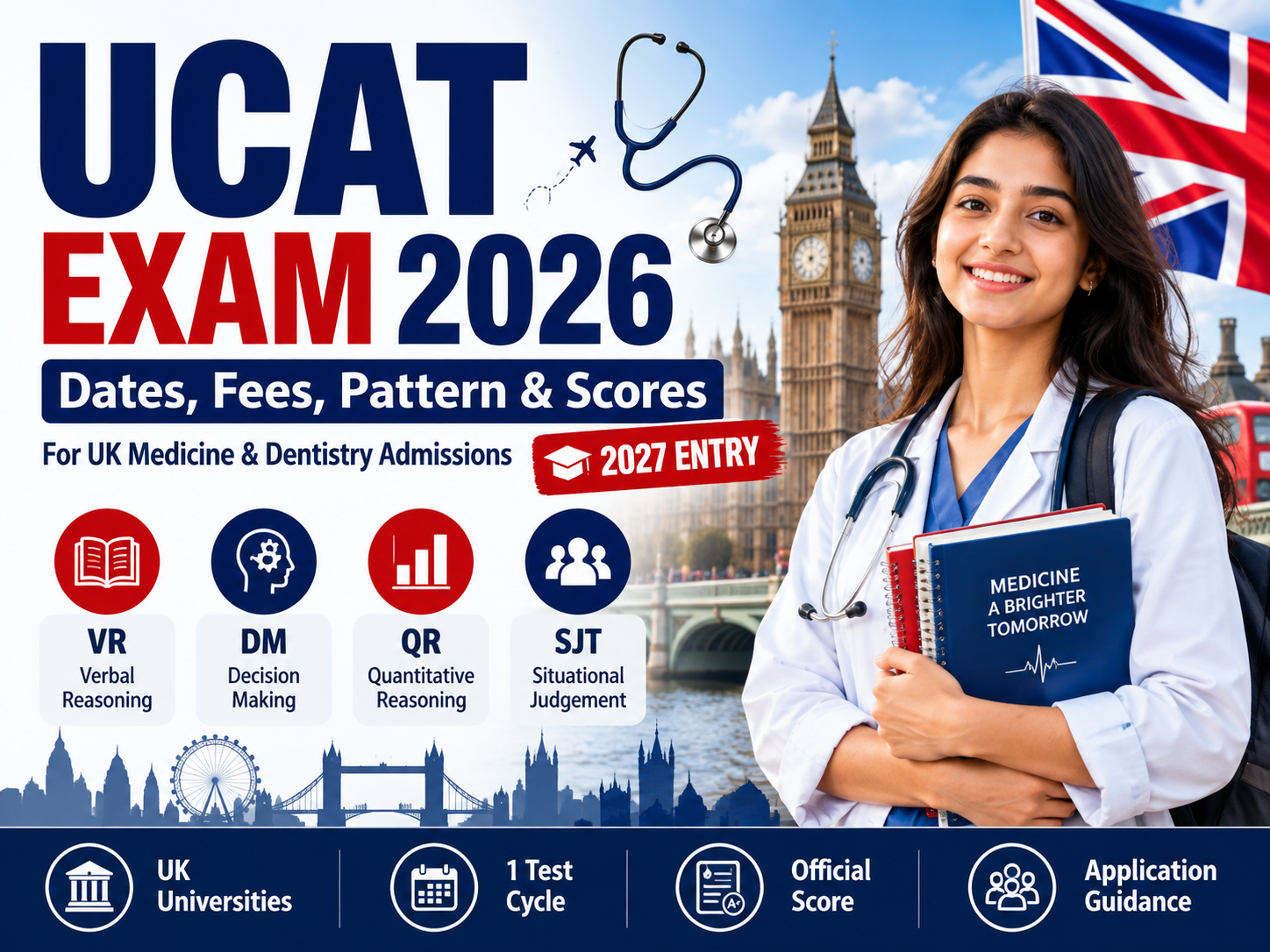
If you are planning to study Medicine or Dentistry in the UK, the UCAT Exam 2026 may be one of the most important parts of your university application.
UCAT stands for University Clinical Aptitude Test. It is a computer-based admissions test used by UK and partner universities when selecting students for medical and dental programmes. Universities normally consider the UCAT alongside academic qualifications, interviews and other admission requirements.
An important point for students is that UCAT 2026 is mainly for students applying for university entry in 2027, or deferred entry in 2028. It is not an exam for 2026 university entry.
As of 25 September 2026, the UCAT 2026 testing period has finished. The final testing date was 24 September 2026, while the UCAS deadline for Medicine and Dentistry applications is 15 October 2026.
What Is the UCAT Exam?
The University Clinical Aptitude Test (UCAT) is an admissions test designed for students applying to selected medical and dental programmes.
Unlike school examinations, UCAT does not primarily test whether you remember Biology, Chemistry or Physics content.
Instead, it assesses abilities such as:
- Critical reading
- Logical reasoning
- Decision-making
- Numerical problem-solving
- Interpretation of information
- Judgement in realistic situations
The exam is taken on a computer, normally at a Pearson test centre. UCAT is available through test centres in more than 130 countries.
Who Needs to Take UCAT 2026?
You generally need to take UCAT 2026 if you are applying for 2027 entry to a Medicine or Dentistry programme at a university that requires UCAT.
The official UCAT Consortium states that applicants to relevant courses at its UK and partner universities must take the test during the appropriate admissions cycle.
Students should always check the individual course requirements before registering because universities may use UCAT differently.
Some universities:
- Apply UCAT cut-off scores
- Rank applicants using UCAT scores
- Combine UCAT with academic performance
- Consider individual section scores
- Use Situational Judgement performance
- Use UCAT only as one part of a wider selection process
There is therefore no single UCAT score that guarantees admission to every university.
UCAT Exam Dates 2026
The official UCAT 2026 schedule was:
| Stage | UCAT 2026 Date |
|---|---|
| Registration opened | 20 May 2026 |
| Test booking opened | 23 June 2026 |
| Testing started | 13 July 2026 |
| Access Arrangements deadline | 10 September 2026 |
| Registration and booking deadline | 16 September 2026 |
| Final UCAT test day | 24 September 2026 |
| UCAS Medicine/Dentistry deadline | 15 October 2026 |
| Results delivered to UK universities | Early November 2026 |
These dates are based on the official UCAT 2026 schedule.
Is UCAT 2026 Registration Still Open?
No.
UCAT 2026 registration and booking are now closed.
The booking deadline was 16 September 2026 at 15:00 UK time, and the final testing date was 24 September 2026. The UCAT Consortium states that exceptions are not made to the booking deadline.
Students who are planning for the next admissions cycle should follow the official UCAT website for the UCAT 2027 schedule, which is expected to be published ahead of the next registration period.
UCAT Exam Pattern 2026
A major change students should know is that Abstract Reasoning is no longer included in UCAT.
Since the change introduced in 2025, UCAT contains three cognitive subtests plus Situational Judgement.
The 2026 exam structure is:
| UCAT Section | Questions | Test Time | Score |
|---|---|---|---|
| Verbal Reasoning | 44 | 22 minutes | 300–900 |
| Decision Making | 35 | 37 minutes | 300–900 |
| Quantitative Reasoning | 36 | 26 minutes | 300–900 |
| Situational Judgement | 69 | 26 minutes | Band 1–4 |
The standard test lasts just under two hours when instruction periods are included.
UCAT Syllabus 2026
UCAT does not have a traditional academic syllabus like many entrance examinations.
Instead, students need to understand the skills tested in each section.
1. Verbal Reasoning
Verbal Reasoning tests how effectively you can read information and evaluate what can reasonably be concluded from it.
You are given written passages followed by questions.
This section tests skills such as:
- Reading quickly
- Identifying relevant information
- Understanding arguments
- Drawing conclusions
- Separating information in the passage from assumptions
There are 44 questions in 22 minutes, which means time management is particularly important.
2. Decision Making
Decision Making assesses your ability to use information logically and reach appropriate conclusions.
Questions can involve:
- Logical puzzles
- Arguments
- Probability
- Statistical information
- Data interpretation
- Deductive reasoning
- Evaluating conclusions
The section contains 35 questions with 37 minutes of testing time.
3. Quantitative Reasoning
Quantitative Reasoning measures how well you can use numerical information to solve problems.
Questions frequently involve information shown through:
- Tables
- Charts
- Graphs
- Percentages
- Ratios
- Rates
- Numerical comparisons
The section contains 36 questions in 26 minutes.
A basic on-screen calculator is available during this section.
4. Situational Judgement
Situational Judgement assesses how candidates respond to situations that may occur during medical or dental education and professional environments.
It looks at areas such as:
- Integrity
- Professional behaviour
- Teamwork
- Perspective taking
- Resilience
- Appropriate judgement
You do not need medical knowledge to answer the questions.
The section contains 69 questions in 26 minutes and is scored from Band 1 to Band 4.
How Is UCAT 2026 Scored?
The three cognitive sections are each scored between 300 and 900.
Therefore:
Verbal Reasoning + Decision Making + Quantitative Reasoning = Total UCAT cognitive score
The overall cognitive score ranges from:
900 to 2700
Situational Judgement is reported separately:
- Band 1 – highest performance
- Band 2
- Band 3
- Band 4 – lowest performance
There is no negative marking for incorrect answers in UCAT.
What Is a Good UCAT Score in 2026?
There is no official universal score that can be called a “good UCAT score” for every university.
Universities use the test differently. Some establish thresholds, while others combine the score with academic results or other admission criteria.
According to preliminary UCAT statistics published using tests completed up to 13 September 2026, the preliminary mean cognitive score was 1970.
The preliminary decile figures included:
| Decile | Preliminary 2026 Total Score |
|---|---|
| 1st | 1630 |
| 2nd | 1750 |
| 3rd | 1840 |
| 4th | 1910 |
| 5th | 1980 |
| 6th | 2040 |
| 7th | 2110 |
| 8th | 2190 |
| 9th | 2300 |
However, these figures were based on 20,794 tests completed up to 13 September and were explicitly labelled preliminary. Final 2026 statistics are published after testing ends, so students should not treat these preliminary numbers as final cut-offs.
A score should instead be considered in relation to:
Your score + university requirements + previous thresholds + academic profile + interview selection process
UCAT Exam Fees 2026
The official UCAT 2026 test fees were:
| Test Location | Fee |
|---|---|
| Test taken in the UK | £70 |
| Test taken outside the UK | £115 |
For Indian students taking UCAT outside the UK, the applicable published test fee was therefore £115.
Students should always check the official fee for the relevant test year before making a booking because fees may change between cycles.
Can Indian Students Take the UCAT?
Yes.
International candidates can take UCAT where suitable Pearson test-centre availability exists. UCAT states that testing is offered through Pearson centres across the UK and in 130+ countries worldwide.
Students in India should use the official Pearson test-centre locator during the booking period to check available locations and appointments.
Do not assume that the same test centre or appointment dates will be available every year.
Can I Take UCAT From Home?
Usually, candidates are expected to sit UCAT at a Pearson test centre.
However, UCAT also operates an online-proctored OnVUE UCAT for candidates who meet specific eligibility requirements, such as situations where accessing an appropriate test centre is particularly difficult.
For 2026, OnVUE testing ran from 13 July to 20 September 2026.
It should not be assumed that every student can simply choose the home-based test instead of attending a test centre.
How Many Times Can I Take UCAT?
You can take UCAT only once during a particular test cycle.
For example, a student applying for 2027 entry who sits UCAT 2026 cannot simply retake the examination later in the same 2026 testing cycle to improve the score.
How Long Is a UCAT Score Valid?
A UCAT score is linked to a particular admissions cycle.
UCAT 2026 results are valid for the 2027 UCAS admissions cycle, including 2027 entry or deferred entry to 2028 where applicable.
Students cannot normally carry an old UCAT result forward and use it for an unrelated later admissions cycle.
When Do UCAT Results Come Out?
One useful feature of UCAT is that candidates receive their scores quickly.
Candidates sitting at Pearson test centres receive a score report before leaving the centre. The score is also normally added to the candidate’s UCAT account within approximately 24 hours.
For UK university applications, UCAT sends the relevant results directly to the universities in early November.
Candidates therefore do not normally need to manually submit their UCAT score to UK university choices.
Which Universities Accept UCAT?
UCAT is used by a large group of UK medical and dental schools.
For the 2026 test cycle, UCAT Consortium universities include institutions such as:
- University of Aberdeen
- University of Birmingham
- University of Bristol
- University of Cambridge
- Cardiff University
- University of Leeds
- University of Leicester
- University of Liverpool
- University of Manchester
- Newcastle University
- University of Nottingham
- University of Oxford
This is not the complete list.
Students should check the official UCAT university list and, more importantly, the specific course page before applying because requirements can differ even within the same university.
How Do Universities Use UCAT Scores?
There is no single admission formula followed by every university.
A university may:
- Set a minimum UCAT threshold
- Rank applicants according to total UCAT score
- Combine UCAT with academic results
- Consider individual subtest scores
- Consider the Situational Judgement Band
- Use UCAT when deciding who progresses to interview
A score that is competitive for one university therefore may not have the same significance at another university.
This is why students should shortlist universities strategically after receiving their score instead of applying based only on university rankings.
UCAT vs UCAT ANZ: What Is the Difference?
Students sometimes confuse UCAT and UCAT ANZ.
UCAT is primarily used for participating UK universities and international partner institutions.
UCAT ANZ is used for participating medical, dental and clinical-science programmes in Australia and New Zealand.
The test content is identical, but the application systems and participating universities differ.
Importantly, candidates are not permitted to sit both UCAT and UCAT ANZ in the same year.
If you are applying to both UK and Australian/New Zealand universities, check the official rules carefully before registering for either test.
How to Prepare for the UCAT Exam
UCAT preparation is different from studying for a theory-heavy examination.
Knowing the question types is important, but performing well also depends heavily on speed, accuracy and decision-making under time pressure.
A practical preparation process can include:
Understand the Format First
Before solving hundreds of questions, understand:
- What each section tests
- Number of questions
- Time available
- Question formats
- Scoring system
Start With Untimed Practice
Initially focus on understanding how each question type works rather than trying to complete everything quickly.
Identify Your Weakest Section
Compare your performance across:
Verbal Reasoning → Decision Making → Quantitative Reasoning → Situational Judgement
Spend more preparation time on the sections where accuracy or timing is weakest.
Introduce Timed Practice
Once you understand the questions, begin solving them under realistic time limits.
UCAT is highly time-constrained, so being able to answer a question eventually is not the same as being able to answer it efficiently during the real test.
Take Full Practice Tests
Complete full-length mock tests so that you become comfortable maintaining concentration across the entire examination.
The UCAT Consortium provides official:
- Question tutorials
- Question banks
- Practice tests
- Test-tool tutorials
UCAT recommends candidates use its official resources because they are designed to represent the live examination.
Common UCAT Preparation Mistakes
Students should avoid:
- Starting timed mocks before understanding question types
- Spending too long on one difficult question
- Ignoring weaker sections
- Memorising answers rather than understanding techniques
- Using outdated preparation material containing Abstract Reasoning
- Assuming every medical university uses the same UCAT cut-off
- Waiting until the final booking dates to schedule the test
- Practising only individual questions and never taking full mocks
One particularly important point for UCAT 2026 and later preparation is to make sure resources reflect the current format. Abstract Reasoning was removed from UCAT beginning with the 2025 test cycle.
UCAT 2026 Checklist for Students
For students applying to Medicine or Dentistry, check the following:
- Does my chosen university require UCAT?
- Am I applying for the correct admissions cycle?
- Have I checked the exact course requirements?
- Did I register within the official deadline?
- Have I booked an appropriate test centre?
- Do I have the correct identification?
- Do I understand all four sections?
- Am I using current UCAT preparation material?
- Have I completed timed practice?
- Have I attempted full mock tests?
- Have I checked how my shortlisted universities use UCAT?
- Have I considered my UCAT result while selecting UCAS choices?
- Am I ready for the 15 October UCAS deadline?
What Should Students Do After Receiving Their UCAT Score?
Do not look at your score in isolation.
Compare your performance with the admissions approach of the universities you are considering.
For example, one university may place substantial emphasis on UCAT while another may combine it with academic results and other selection factors.
After receiving your score:
UCAT result → Check university requirements → Shortlist realistic programmes → Prepare remaining application → Submit UCAS application
For Medicine and Dentistry applications in the 2026 admissions cycle, the UCAS deadline is 15 October 2026.
Planning to Study Medicine in the UK from India?
Indian students planning to study Medicine or Dentistry in the UK need to look beyond the UCAT alone.
The complete application can involve:
- University selection
- Academic eligibility
- UCAT requirements
- English-language requirements
- UCAS application
- Application documents
- Interviews
- Financial planning
- Student visa process
BlueRibbon Overseas can help students understand university options and plan their UK study application based on their academic profile, career goals and individual university requirements.
UCAT registration and testing itself should always be completed through the official UCAT system.
Frequently Asked Questions About UCAT Exam 2026
What is the full form of UCAT?
UCAT stands for University Clinical Aptitude Test. It is used by participating universities when selecting applicants for Medicine and Dentistry programmes.
Is UCAT required for studying Medicine in the UK?
UCAT is required for relevant medical and dental programmes at UCAT Consortium universities. However, students must check the specific requirements of each course before applying.
When was UCAT 2026 held?
The UCAT 2026 testing period ran from 13 July to 24 September 2026.
Is UCAT 2026 registration still open?
No. Registration and test booking closed on 16 September 2026, and testing ended on 24 September 2026.
What is the UCAT 2026 exam fee for Indian students?
The official 2026 fee for tests taken outside the UK was £115.
What is the maximum UCAT score?
The total score for the three cognitive sections ranges from 900 to 2700. Situational Judgement is scored separately from Band 1 to Band 4.
Is there negative marking in UCAT?
No. The official UCAT scoring guidance states that there is no negative marking for incorrect answers.
Is Abstract Reasoning included in UCAT 2026?
No. Abstract Reasoning was removed from UCAT beginning with the 2025 test. The current cognitive sections are Verbal Reasoning, Decision Making and Quantitative Reasoning.
Can Indian students take UCAT?
Yes. International candidates can sit UCAT outside the UK where suitable Pearson test-centre appointments are available. UCAT operates through Pearson centres in more than 130 countries.
Can I take UCAT more than once in 2026?
No. Candidates are permitted to sit UCAT only once in each test cycle.
Is 2000 a good UCAT score in 2026?
There is no universal “good” score because universities use UCAT differently. Preliminary 2026 statistics showed a mean total score of 1970 up to 13 September, but final statistics were not yet available at that stage. Students should compare their result with the requirements and previous selection information of individual universities.
When will universities receive UCAT 2026 results?
UCAT states that results for UK university choices will be delivered directly to universities in early November 2026.
Is UCAT 2026 for 2026 or 2027 university admission?
UCAT 2026 is primarily for students applying for 2027 entry, including deferred entry to 2028 where applicable.