
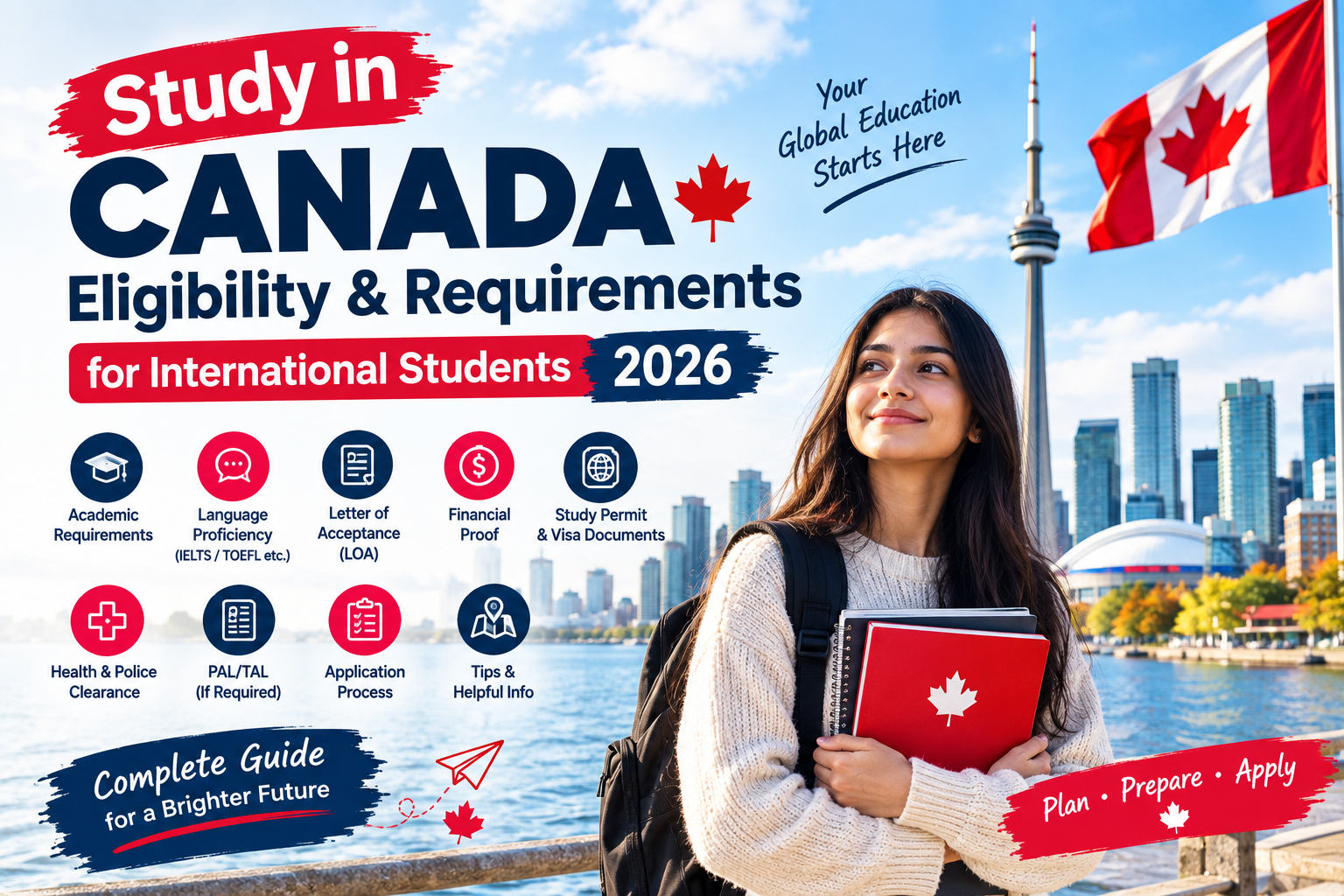
Canada remains a popular destination for international students because of its universities, colleges, research opportunities and multicultural environment. However, getting admission to a Canadian institution and obtaining a study permit are two separate steps.
Students must meet the academic requirements of their chosen programme, receive an acceptance letter from an eligible institution and demonstrate that they can support themselves financially. They must also satisfy Canada’s immigration requirements, including health, security and temporary-residence conditions.
Who Can Study in Canada?
International students generally need a study permit if they plan to study in Canada for more than six months. The permit allows eligible foreign nationals to study at a designated learning institution (DLI).
To qualify, applicants generally need to:
- Be accepted by a designated learning institution in Canada.
- Have sufficient funds to pay tuition, living expenses and return transportation.
- Meet health and security requirements.
- Have no criminal record, where applicable.
- Convince the immigration officer that they will leave Canada when their authorised stay ends, unless they obtain another valid status.
These are the core study-permit eligibility requirements listed by Immigration, Refugees and Citizenship Canada (IRCC).
Canada Study Eligibility Checklist
Before applying, international students should review the following checklist:
| Requirement | What you need |
|---|---|
| Academic eligibility | Qualifications required by the chosen institution and programme |
| Admission | Letter of Acceptance (LOA) from a DLI |
| Language proficiency | IELTS, TOEFL, PTE, Duolingo or another accepted test, if required |
| Financial capacity | Proof of tuition, living expenses and transportation funds |
| PAL/TAL | Provincial or Territorial Attestation Letter, if required |
| Quebec requirement | CAQ, if studying in Quebec |
| Passport | Valid passport or travel document |
| Study plan | A credible explanation of your academic goals |
| Biometrics | Required applicants must provide biometrics |
| Medical examination | If required based on the applicant’s circumstances |
| Police certificate | If required |
| Temporary-residence requirement | Evidence that the applicant will comply with immigration conditions |
Not every applicant submits exactly the same documents. Requirements can vary based on the programme, province, country of application and individual circumstances.
1. Academic Requirements to Study in Canada
Academic eligibility depends on the level and programme you choose. Canadian institutions assess your previous education, grades, prerequisite subjects and other admission criteria.
For undergraduate programmes
Students applying for a bachelor’s degree or other undergraduate programme generally need:
- Completion of Class 12 or equivalent secondary education.
- Academic transcripts and certificates.
- Required subjects for the selected programme.
- Minimum grades specified by the institution.
- English- or French-language proficiency, where required.
- Additional documents such as a portfolio or statement, if applicable.
For example, engineering programmes may require mathematics and physics, while business programmes may have different subject prerequisites.
For postgraduate programmes
Students applying for a master’s degree, graduate certificate or postgraduate diploma may need:
- A recognised bachelor’s degree or equivalent qualification.
- Academic transcripts.
- Minimum GPA or percentage requirements.
- Relevant academic background or prerequisite subjects.
- Statement of Purpose (SOP), if requested.
- Letters of recommendation, if requested.
- CV or résumé, particularly for professional programmes.
- Work experience, if required by the programme.
Important: There is no single academic percentage that guarantees admission to every Canadian institution. Each university or college sets its own admission requirements.
Do backlogs affect admission?
Backlogs do not automatically mean that a student cannot study in Canada. However, institutions may consider:
- Number of backlogs
- Academic performance
- Course completion history
- Time taken to complete the degree
- Explanation for academic gaps
- Overall profile
The final decision depends on the institution and programme.
2. English-Language Requirements
Most international students applying to English-taught programmes must demonstrate English-language proficiency unless they qualify for an exemption.
Commonly accepted tests may include:
- IELTS Academic
- TOEFL iBT
- PTE Academic
- Duolingo English Test
- Other tests accepted by the specific institution
Typical score expectations
The required score depends on the university, college and programme. As a general guide, many institutions may look for an IELTS Academic score around 6.0–6.5, while some competitive programmes may require higher scores.
| Study Level | Common IELTS Academic Range* |
|---|---|
| Undergraduate | Around 6.0–6.5 |
| Postgraduate | Around 6.5–7.0 |
| Competitive or professional programmes | May require higher scores |
These are indicative ranges, not universal Canadian visa requirements. Always check the exact requirements of your chosen institution.
Is IELTS mandatory for a Canada study visa?
IELTS is not universally mandatory for every Canadian study-permit applicant.
The institution determines which language tests it accepts for admission. If you receive admission without IELTS through an accepted alternative or exemption, that does not automatically mean every institution will accept the same arrangement.
Students should check:
- The university or college’s language requirements.
- Whether the programme accepts alternatives such as PTE or Duolingo.
- Whether an English-medium education exemption is available.
- Whether the institution requires a specific test for the chosen programme.
3. Letter of Acceptance from a Canadian DLI
A Letter of Acceptance (LOA) is one of the most important documents for a study-permit application.
You must generally receive admission from a Designated Learning Institution (DLI). A DLI is a Canadian school approved to host international students.
The LOA generally includes information such as:
- Student’s name
- Institution name
- Programme or course
- Duration of study
- Tuition fees
- Start date
- Expected completion date
- Conditions of admission, if any
Students should verify the institution on Canada’s official Designated Learning Institutions list before applying. Not every programme at every DLI is necessarily eligible for a Post-Graduation Work Permit (PGWP), so students interested in working after graduation should check programme-specific eligibility separately.
Conditional admission
Some institutions may issue a conditional offer if a student must complete prerequisites, language training or another requirement before starting the main programme.
Students should understand whether the conditions must be completed before applying for a study permit or before beginning the intended programme.
4. PAL/TAL Requirement for 2026
The Provincial Attestation Letter (PAL) or Territorial Attestation Letter (TAL) confirms that a student has been allocated a place within the relevant province or territory’s international student system.
For most applicants, a PAL/TAL is required before applying for a study permit.
Important 2026 exemption
Starting 1 January 2026, students applying for a degree-granting master’s or doctoral programme at a public designated learning institution generally do not need a PAL/TAL.
However:
- The programme must meet the applicable graduate-degree conditions.
- The institution must be a qualifying public DLI.
- Students studying in Quebec must still meet Quebec’s requirements.
- Other applicants, including many undergraduate and non-degree students, may still need a PAL/TAL.
The official IRCC guidance confirms this graduate-level exemption.
What about Quebec?
Students planning to study in Quebec generally need a Quebec Acceptance Certificate (CAQ), subject to applicable exemptions and provincial rules.
The CAQ serves as the relevant attestation document for the Quebec process in applicable cases. Students should check the latest Quebec requirements before submitting their application.
5. Financial Requirements to Study in Canada
Financial proof is one of the most important parts of a Canadian study-permit application.
Applicants must demonstrate that they have enough money to cover:
- Tuition fees
- Living expenses
- Return transportation
- Expenses for accompanying family members, if applicable
IRCC assesses whether the funds are sufficient and whether their source is credible. Applicants must demonstrate financial capacity without relying on work in Canada to meet the initial requirement.
Canada Proof of Funds Requirement 2026
For applications made on or after 1 September 2026, the minimum living-expense amount for one applicant outside Quebec is:
| Number of family members | Required annual living funds |
|---|---|
| 1 person | CAD $23,448 |
| 2 people | CAD $29,192 |
| 3 people | CAD $35,888 |
| 4 people | CAD $43,572 |
| 5 people | CAD $49,419 |
| 6 people | CAD $55,736 |
| 7 people | CAD $62,054 |
| Each additional person | CAD $6,318 |
These figures cover living expenses only. Tuition fees and transportation costs must be demonstrated separately.
Example for a single student
Suppose a student has:
- First-year tuition: CAD $25,000
- Required annual living funds: CAD $23,448
- Estimated transportation: CAD $2,000
The student should plan to demonstrate funds covering approximately:
CAD $25,000 + CAD $23,448 + CAD $2,000 = CAD $50,448
This is an illustration, not a universal cost estimate. Actual tuition and transportation costs vary.
Acceptable proof of funds
Depending on the applicant’s circumstances, documents may include:
- Bank statements
- Education loan approval or sanction letter
- Scholarship letter
- Proof of tuition payment
- Guaranteed Investment Certificate (GIC), where applicable
- Fixed deposits or other financial documents
- Sponsor’s employment and income documents
- Proof of relationship with the financial sponsor
- Documents explaining the source of funds
IRCC states that bank statements may be used as proof and that applicants should provide documentation showing the source of income or funds.
Is GIC mandatory for everyone?
No. A GIC is not a universal study-permit requirement for every applicant.
The previous Student Direct Stream (SDS) was closed on 8 November 2024. Students now apply through the regular study-permit process, where financial evidence is assessed under the applicable rules. Applicants should not assume that an SDS-style GIC requirement applies to every application.
6. Study Plan and Statement of Purpose
A study plan or Statement of Purpose can help explain why you want to study in Canada and how the programme fits your academic and professional goals.
A strong study plan should clearly explain:
- Why you selected the programme
- Why you chose the institution
- How the programme relates to your previous education
- How it supports your career plans
- Why Canada is suitable for your academic goals
- How you plan to finance your studies
- Any relevant academic gaps or career changes
The information should be consistent with your academic records, financial documents and application history.
A study permit is not granted simply because a student has received admission. The officer must also be satisfied that the applicant meets the immigration requirements and will comply with the conditions of the permit.
7. Passport and Identity Documents
Applicants generally need a valid passport or travel document.
Common identity documents include:
- Valid passport
- Passport-size photographs, where required
- Previous passports, if relevant
- Birth certificate, where requested
- Marriage certificate, if applicable
- Family information forms, where required
Make sure the name and date of birth are consistent across your passport, academic documents and application forms.
8. Medical Examination and Police Certificate
Some applicants may need a medical examination depending on factors such as:
- Intended length of stay
- Country of residence or travel history
- Type of work or study
- Other immigration requirements
A police certificate may also be required depending on the applicant’s circumstances.
Applicants should follow the instructions provided by IRCC and the relevant visa office rather than arranging unnecessary documents without checking the requirements.
9. Biometrics Requirement
Many applicants must provide biometrics, which generally include fingerprints and a photograph.
After submitting the application, IRCC may issue a Biometrics Instruction Letter (BIL) explaining how and where to complete the process.
Applicants should follow the instructions and attend their biometrics appointment within the specified timeframe.
10. Study Permit Application Process
The general process for international students is:
Step 1: Choose a programme
Research universities, colleges and programmes based on:
- Academic eligibility
- Tuition fees
- Location
- Programme duration
- Career relevance
- DLI status
- PGWP eligibility, if relevant
Step 2: Apply to the institution
Submit the required academic and supporting documents.
Step 3: Receive the Letter of Acceptance
Once admitted, review the programme details and conditions carefully.
Step 4: Obtain PAL/TAL or CAQ, if required
Most applicable applicants need the relevant attestation document. Eligible public-institution master’s and doctoral applicants may be exempt from PAL/TAL in 2026.
Step 5: Prepare financial documents
Show sufficient funds for tuition, living expenses and transportation.
Step 6: Prepare the study-permit application
Submit the required forms, passport, LOA, financial proof and supporting documents.
Step 7: Complete biometrics and medical requirements
Complete these if instructed or required.
Step 8: Wait for a decision
IRCC may request additional information or documents during processing.
Step 9: Prepare for travel
If approved, follow the instructions for obtaining your travel documents and entering Canada.
The official application process and document requirements are available through IRCC.
Canada Study Visa Requirements: Complete Document Checklist
Before submitting your application, review this practical checklist:
- Valid passport
- Letter of Acceptance from a DLI
- PAL/TAL, if required
- CAQ, if studying in Quebec
- Academic transcripts
- Degree or completion certificates
- English- or French-language test result, if required
- Proof of tuition payment, if applicable
- Proof of financial support
- Education loan or scholarship documents, if applicable
- Sponsor’s financial and employment documents, if applicable
- Statement of Purpose or study plan, if required
- CV or résumé, if relevant
- Medical examination documents, if required
- Police certificate, if required
- Biometrics, if required
- Additional documents requested by the visa office
The exact checklist can vary by country and applicant profile, so students should use the official IRCC instructions for their application.
Can International Students Work While Studying in Canada?
Eligible international students may be allowed to work while studying, subject to the conditions of their study permit and applicable immigration rules.
However, students should not treat part-time work as a substitute for the financial proof required during the application process.
Before planning employment, students should check:
- Whether their study permit authorises work
- Whether they meet the eligibility conditions
- The applicable work-hour rules
- Whether their programme and study status remain compliant
Students must also continue meeting their study-permit conditions, including actively pursuing their studies.
Does Every Canadian Programme Qualify for a PGWP?
No. Admission to a Canadian institution does not automatically guarantee eligibility for a Post-Graduation Work Permit (PGWP).
PGWP eligibility depends on several factors, including:
- The institution
- The programme
- The level of study
- Programme duration
- Language requirements
- Field-of-study requirements, where applicable
- The date and circumstances of the study-permit application
Students who want to work in Canada after graduation should verify PGWP eligibility before paying tuition or accepting an offer. IRCC’s DLI list identifies institutions and provides information about eligible programmes, but students must review the applicable conditions carefully.
Common Reasons Canada Study-Permit Applications May Be Refused
A study-permit application can be refused for several reasons, including:
- Insufficient or unclear financial proof
- Unexplained source of funds
- Weak academic progression
- Unconvincing study plan
- Inconsistencies in documents
- Failure to demonstrate the purpose of study
- Failure to satisfy the officer that the applicant will leave Canada when required
- Missing or inaccurate documents
- Failure to meet health or admissibility requirements
IRCC specifically notes that an application may be refused if the applicant does not show sufficient financial support, fails to convince the officer that the primary purpose is study, or does not demonstrate that they will leave Canada at the end of the authorised period.
Frequently Asked Questions
What are the basic eligibility requirements to study in Canada?
You generally need admission to a DLI, sufficient funds, good health where required, a satisfactory admissibility record and evidence that you will comply with the conditions of your stay.
Is IELTS mandatory for a Canada study visa?
IELTS is not universally mandatory for every applicant. Language requirements depend on the institution, programme and accepted exemptions or alternatives.
How much bank balance is required for Canada in 2026?
For applications made on or after 1 September 2026, a single applicant outside Quebec must generally show CAD $23,448 for annual living expenses, in addition to tuition and transportation costs.
Is PAL required for a master’s degree in Canada in 2026?
Students applying for a degree-granting master’s or doctoral programme at a qualifying public DLI generally do not need a PAL/TAL starting 1 January 2026. Quebec requirements still apply where relevant.
Can students with study gaps apply for Canada?
Yes. A study gap does not automatically make a student ineligible, but the gap should be explained clearly and supported by credible documents where appropriate.
Can students with backlogs study in Canada?
Yes, depending on the institution’s admission criteria. Backlogs may be assessed alongside academic performance and the overall profile.
Do I need a study permit for a short course?
Not always. Some programmes lasting six months or less may be studied without a study permit if they meet the applicable exemption conditions. Students should verify their specific circumstances using IRCC’s official guidance.
Can I work in Canada after studying?
Some graduates may qualify for a PGWP, but eligibility is not automatic. It depends on the institution, programme and other applicable requirements.